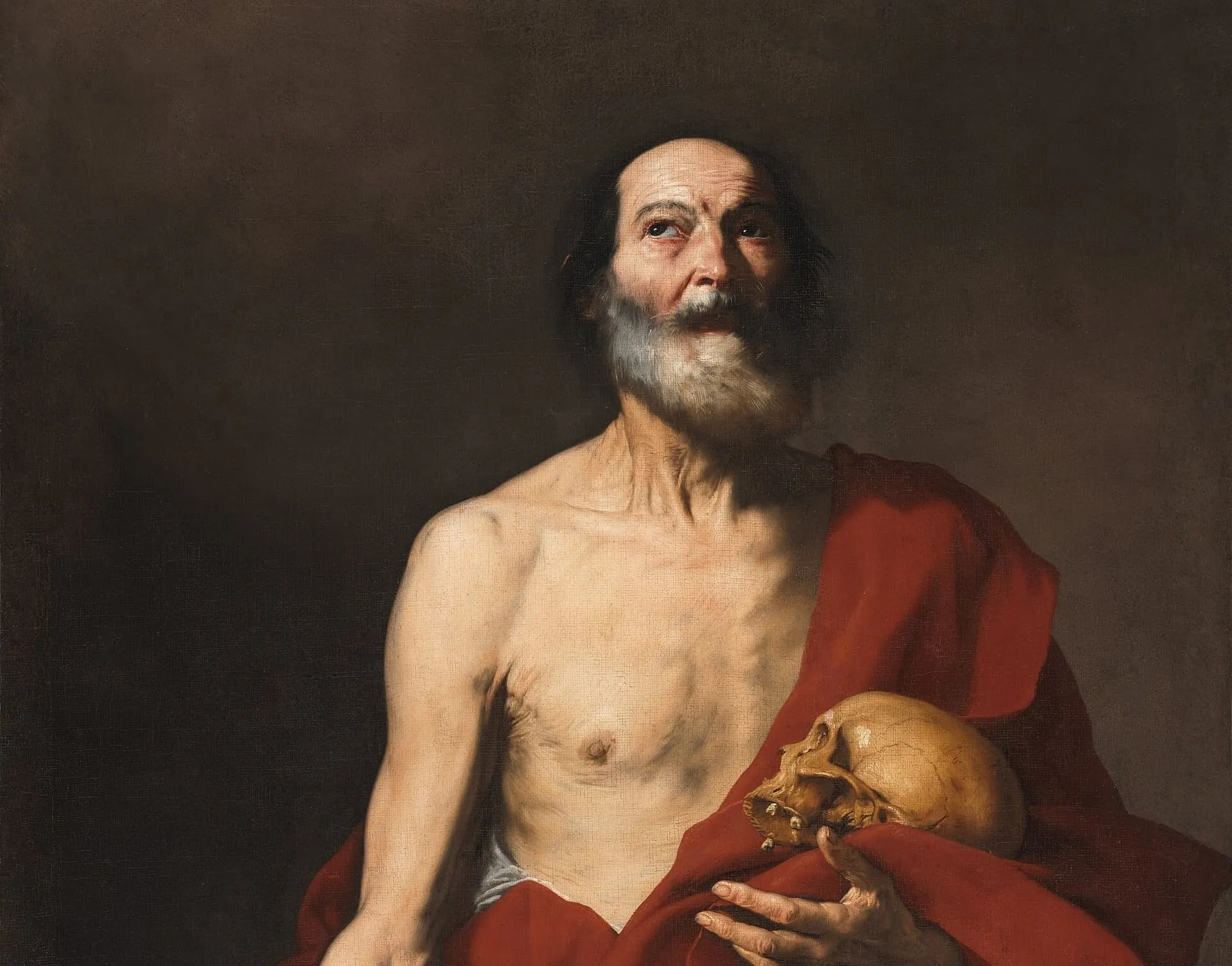

From the Editors: The artwork for this essay features Saint Jerome, a man devoted to disciplining his mind in pursuit of God. Christianity has always held the deepest and truest understanding of human nature, including the mind and soul. While giving psychological study its due, Chesterton thought that the theories of modern psychology were half-baked, not fully understanding human nature, and that its theories become dangerous, especially to the religious and poor, if given authority by the state.
G. K. Chesterton was five when the field of psychology emerged as an independent discipline in 1879 with Wilhelm Wundt’s laboratory at the University of Leipzig. While a variety of schools of psychological thought emerged during his own lifetime (1874-1936), Chesterton found them all wanting in various ways. More importantly, however, he found the deployment of a purported expertise in psychology on behalf of the state to be a dangerous proposition. Without a real knowledge of what sanity was, the power to determine insanity gave psychological doctors massive power over others.
Sanity and Insanity
Chesterton’s career was dedicated to diagnosing insanity and prescribing sanity at the individual, social, cultural, and political level. Words like “lunacy,” “madness,” and “sanity” mark many of his nonfiction essays about all manner of topics. He summarized many of his political and economic views in a book titled An Outline of Sanity. So, too, in his fiction the battle for sanity was apparent from the beginning. Many of his stories hinge on the sanity of individuals and groups. His most successful novel, The Man Who Was Thursday (1908), was a harrowing dream about the borders between madness and sanity. The Ball and the Cross (1909) depicted the battle for truth between atheism and Christianity as played out on a legal stage in which psychology, whose Greek roots indicate it is the study of the mind or soul—psyche—can be used to avoid that most important question for mental and spiritual life and health.
The end result is that popular psychology becomes a matter of half-baked theories known only through sloganeering.
That those doctors of mental health might not only be unhelpful but even hindrances to it should not be surprising given the outlook they quite often shared. Despite the technical and scientific progress of the modern world, Chesterton viewed the assumptions and arrangements of modernity in general and medicine in particular as traveling away from the “philosophy of sanity” into various visions of insanity taken as normative.
The problem, Chesterton understood, was that the true “philosophy of sanity” was composed of the truths handed down by all humanity as a heritage and completed in Christian orthodoxy. Without that full vision of the human person, what one understood to be sane could only be a very partial truth that left out or even covered over other, often more important, aspects of our fearfully and wonderfully made being. Dominant psychological theories were thus heresies about the nature of man, made in the image of God.
Because the theories failed to truly comprehend human nature, Chesterton believed, and because they refused to acknowledge the truths either learned from nursery rhymes or the Christian creeds, they were doomed to be adopted and abandoned rapidly as psychologists exchanged one half-truth for another. A 1921 essay in The Illustrated London News observes that the theories are too often merely academic in the worst sense: “In this age of child-psychology nobody pays any attention to the actual psychology of the child. All that seems to matter is the psychology of the psychologist and the particular theory or train of thought that he is maintaining against another psychologist.”


The end result is that popular psychology becomes a matter of half-baked theories known only through sloganeering. “What the present generation knows,” he wrote in a 1929 essay in Vanity Fair titled “The Unpsychological Age,” “is a number of catch phrases taken from one particular theory, which happens to be the last theory, and which will therefore be blown to bits by the next theory.”
As examples of catch phrases, Chesterton offers the “Inferiority Complex” and the “Oedipus Complex.” The former he describes as “what Christians used to call Modesty and gentlemen Manners.” And he notes that “the much older and much more profound Psychology of the Christian religion was founded on the very ancient discovery that a superiority complex was the beginning of all evil.”
Concerning the latter, Chesterton notes that such a complex story of murder and “other odd things” is “thought likely to brighten the lives of all Bright Young Things.” Popular psychology misses out on the “science,” or knowledge, that “is imbedded in the word ‘Conscience.’” Such a picture of the human being misses out on that which St. Paul observed to the Romans was “written on their hearts,” namely, what God’s moral law requires, to which “their conscience also bears witness and their conflicting thoughts accuse or perhaps excuse them” (Romans 2:15).
“These new complexes,” Chesterton observes, “are not very complex.” In fact, if you compare them “with the subtlety of the old spiritual ideas, their simplicity is babyish.” Psychological theorists all attempt to get at the nooks and crannies of human thought and behavior without even mastering “the rudiments of the study of which they talk so much.”
“Our fathers did not talk about Psychology,” Chesterton writes; “they talked about a knowledge of human nature. But they had it; and we have not.” As he goes on to detail, the very nature of modern life violates the most basic principles. As a prime example, Chesterton notes that without any sense of normal (much less ascetical) life, pleasure seeking is a futile endeavor. The “law of Contrast” is unbreakable. Hence the problem with “Boredom.” Spending time in the fast lane or the limelight can only be pleasant if it is a break from the daily pace and the gentle darkness of shadows and evening.
The problem with what was called “The Psychological Age” is that it is populated by a “strange generation which claims to study the mind without using it.” Thus, they are vulnerable to the false claims to scientific authority propounding “dogmas concerned with domestic and very delicate human relations.” These dogmas, Chesterton writes in his essay “On Quacks in the Home,” are a “false science.” In short, “quackery.”
 W. Keith Campbell
More on Psychological Madness
Psychoanalysis
Chesterton dealt specifically with the two theories of Psychoanalysis and Behaviorism. Chesterton’s approach to the first is perhaps known to those who’ve heard his poem about Sigmund Freud:
The ignorant pronounce it Frood
To cavil or applaud
The well-informed pronounce it Froyd
But I pronounce it Fraud.
His 1923 essay “The Game of Psychoanalysis” lays out this basic view in more detail.
First, though sexual instinct is strong and colors many other things, psychoanalysis reduces everything to sex and asserts “the sexual character of all sorts of non-sexual affection.”
Observing that it is literally “such stuff as dreams are made of,” Chesterton notes that the “new scientific notion…divides itself into a smaller element, which may in a more serious sense be called stuff, and a much larger element which more correctly be called stuffing.”
He writes that “the nucleus of genuine psychological study has little or nothing to do with the fashion of psychoanalysis.” Chesterton has no doubt that “there is some careful and solid work being done in the testing of memory, subconsciousness, and association of ideas,” but he argues that this particular movement has become merely one of the “historic movements” he labels “the insane simplifications.”
First, though sexual instinct is strong and colors many other things, psychoanalysis reduces everything to sex and asserts “the sexual character of all sorts of non-sexual affection.” Second, it talks about “the Unconscious” as if it were actually conscious thought and debates how to treat it. If this aspect doesn’t disappear, Chesterton asserts, it will “remain as a superstition.” To Chesterton, psychoanalysis is more “mythology” than science.
Behaviorism
Chesterton’s essay on the Behaviorist school, which held that human behavior can be explained without reference to free will as either reflexive actions provoked by external stimuli or reflexive actions conditioned by previous punishments or rewards, objects to its attempt to make human behavior simply a matter of physiology. It is a matter of putting all thought into the physical matter of man. As with his approach to Psychoanalysis, Chesterton doesn’t deny there is some truth in it, and he suggests mischievously, “If we were only allowed to accept scientific suggestion, as jokes, we could sometimes get some serious good out of them.”
Chesterton objected strongly to such power being given to small numbers of doctors. First, he worried that, in an increasingly secular society, those claiming religious belief would be declared insane.
What is the truth in this theory? Chesterton affirms that “the suggestion about mind and muscle,” namely that human thought is connected to bodily being, has something to it. As with most half-truths, however, the problem comes in what is omitted: “there may be nothing but nonsense in an attempt to affirm muscle and deny mind.” Rejecting any psychological theory that denies the spiritual and immaterial element in man is, well, a no-brainer.
The Danger of Psychological Experts
If psychologists were merely philosophers seeking an audience, Chesterton might not have minded. But Chesterton saw that giving such experts with their half-baked theories any authority was dangerous. In his 1996 article “G.K.C.’s Methodical Madness: Sanity and Social Control in Chesterton,” Adam Schwartz lays out the historical context for Chesterton’s writings. Nineteenth-century England was crazy for social reforms—particularly dealing with the insane. The 1845 and 1890 Lunacy Acts gave nearly exclusive authority to the medical profession to label patients insane and put them in asylums. On the word of two doctors, one could be confined. The end result was a rapid increase in the number of people sent to asylums—and little legal recourse. As Schwartz puts it, “the literature of unjust confinement suggests a substantial fear that people were effectively assumed to be insane and had to prove otherwise.”
There is no doubt that we have seen attempts by “experts” in half-baked psychological theories to discriminate against religious people. Opposition to unnatural urges (e.g. homosexual ones) and beliefs (e.g. that one is, despite one’s sex, really internally the opposite) is labeled a “phobia” to denote irrational fear.
Chesterton objected strongly to such power being given to small numbers of doctors. First, he worried that, in an increasingly secular society, those claiming religious belief would be declared insane.
Second, Chesterton worried that such authority would “bring all human life under the Lunacy Laws.” Remember that his observations about psychological “quackery” were about “domestic and human relations.” In short, the Psychological State would be all-encompassing since it reaches into personal life.
Third, Chesterton saw that this state-approved rule of experts would be applied to those who were poor most of all. His opposition to the 1913 Mental Deficiency Act, which dealt with “the feeble minded,” was predicated again on the power given to a Board of Control that could take children from their families. And poorer families had a harder time making a case for keeping their children. In Eugenics and Other Evils (1922), Chesterton wrote that “feeble-mindedness is a new phrase under which you might segregate anybody…. And the vaguer the charge is the less they will be able to disprove it.”
Why it Matters Today
As the last quotation indicates, Chesterton’s worries were in the context of an age obsessed with eugenics. As Schwartz observes, while many simply wanted to sterilize the “feeble-minded” or insane, some thought extermination was the way to deal with such problems.
There is no doubt that we have seen attempts by “experts” in half-baked psychological theories to discriminate against religious people. Opposition to unnatural urges (e.g. homosexual ones) and beliefs (e.g. that one is, despite one’s sex, really internally the opposite) is labeled a “phobia” to denote irrational fear. So, too, do we have interference in more and more aspects of the lives of ordinary people—all while truly disturbed people are often left to their own devices. Echoing past worries about the “feeble-minded,” some experts test the foundational bonds of family life and advocate for aborting children who might be mentally disabled.
Chesterton gives modern psychology its due, but no more. He recognizes true claims within various psychological theories while clarifying their limitations and assumptions. He also recognizes the temptation to merge psychological expertise with state power. Who, after all, could possibly doubt the benefits of authorizing “scientific” psychological experts on sanity and mental health helping citizens at every level of their lives, for their good and the good of all? Chesterton saw that a state that deploys psychological expertise based on half-truths would be a full disaster. We know that he was right.