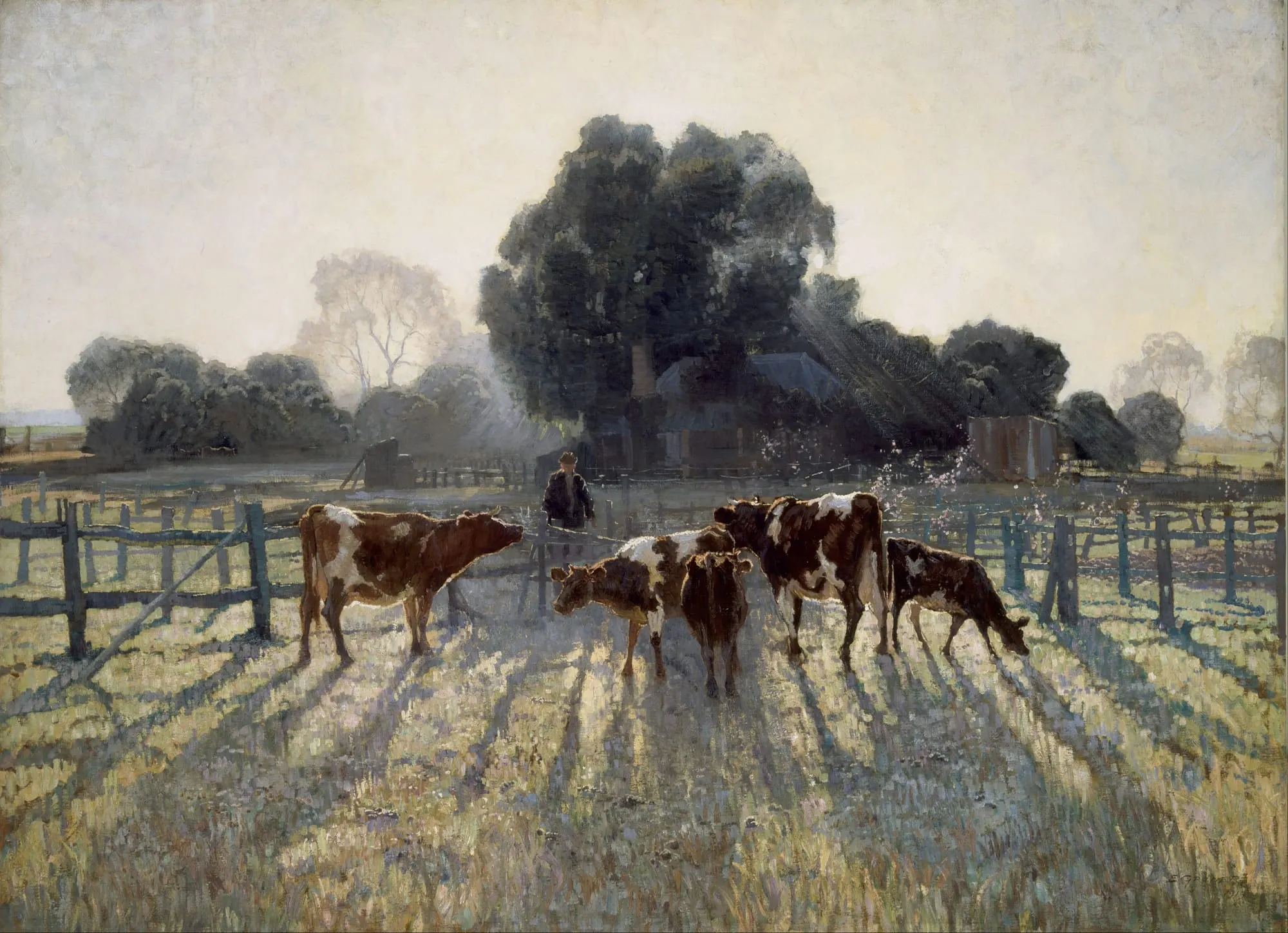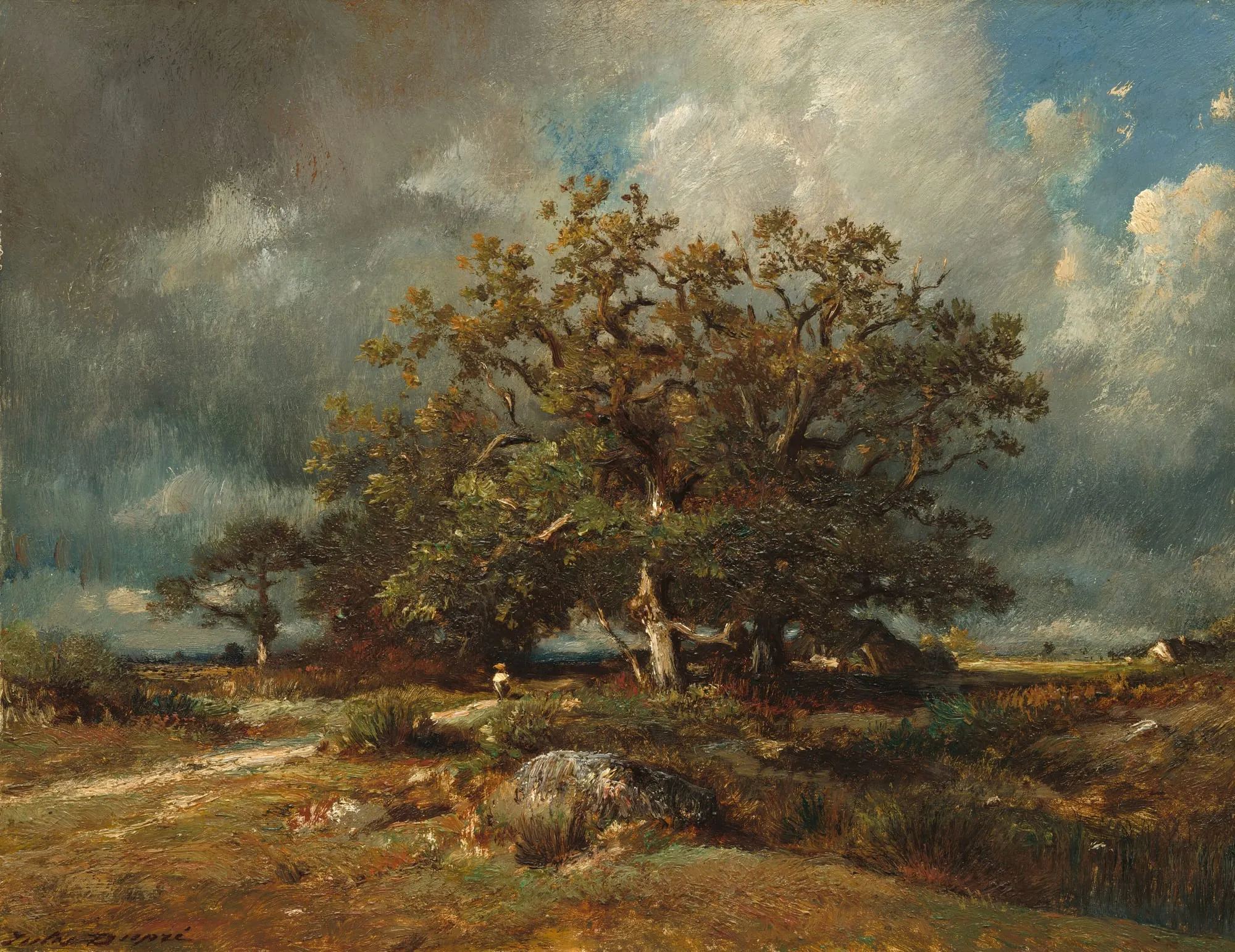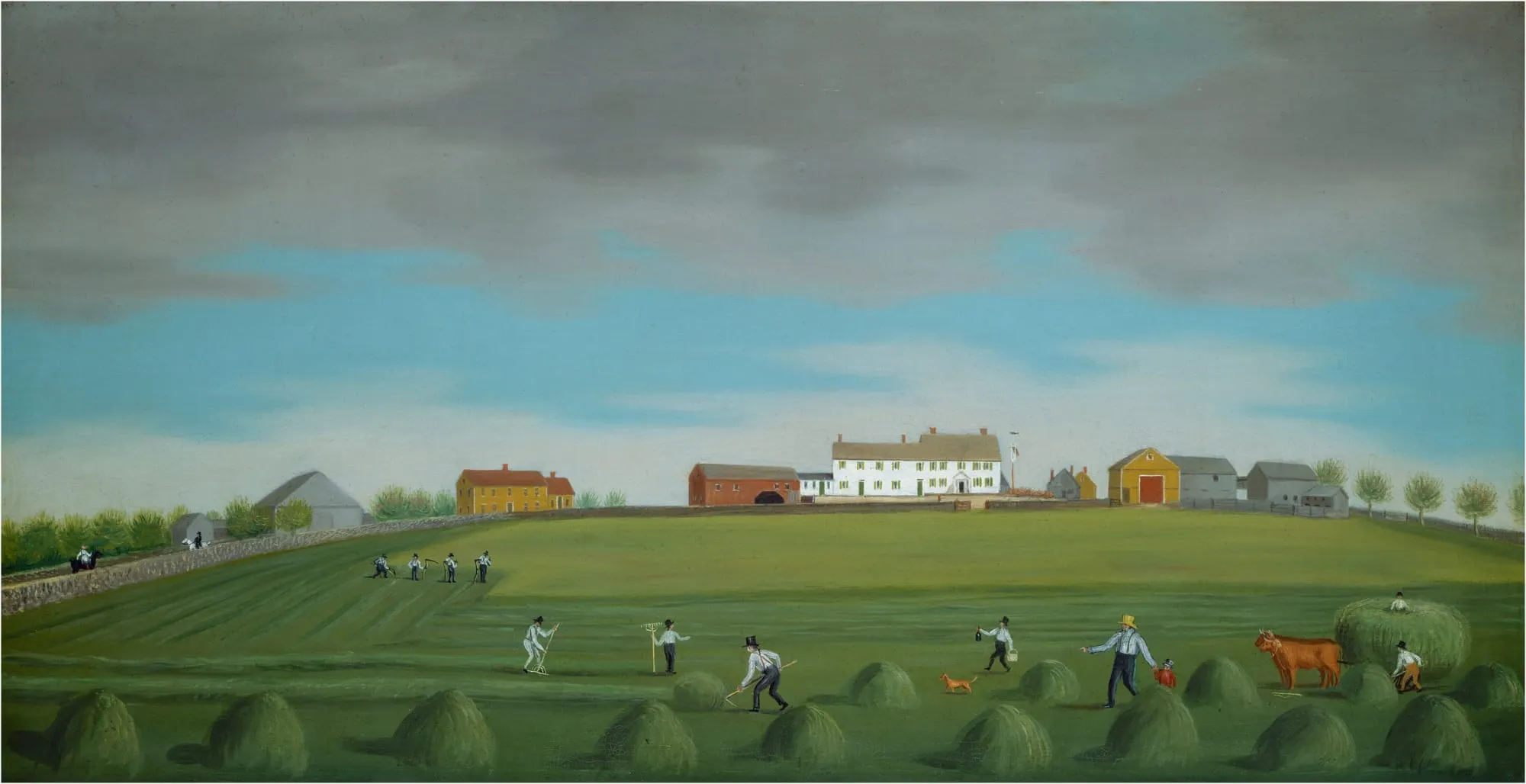
From the Editors: This article's artwork depicts a New England farm in the early 1800s, more generally representing any kind of business - whether a restaurant, a computer repair shop, or another business - whose community knows who's in charge and who's accountable, and whose workers are not controlled by some bureaucracy. To summarize: the kind of business that runs on and produces independence: independence from centralized authority, lopsided influence, and uniformity, and independence for ownership, accountability, and uniqueness. After reading this article, think about what companies you buy from who can hear your voice most clearly.
Everybody said the great modern war was between Capitalism and Socialism. We said there was no war; for it was only between Centralization and Centralization.
– G.K. Chesterton
Since Distributism first arose in the 1920's, it has always been a difficult thing to explain. And a difficult thing to defend.
When it is not dismissed out of hand, it is dismissed with a word or two of condescension. Even if Distributism might sound good – so the argument goes – it's impossible. It can't be done.
The response to this argument is: it can be done, and it is being done, and the idea is gaining traction for the simple reason that craft-brewed beer tastes better than industrial-brewed beer.
I once gave a talk on Distributism to a not entirely hostile audience. Some folks present were already fairly familiar with it and quite in favor of it, and while many were not familiar with it, they were genuinely interested to learn more. But a strong faction took the posture of skeptics, both the scowling kind and the smirking kind. They really could not imagine that there was anything wrong with capitalism, or that there was anything right with anything other than capitalism.
One of these fine fellows, who sat with arms folded during the talk, waited to ask his question at the end, which was: “Dale, how did you get to Wichita today?”
I knew where he was going with that one. So I gave him an answer he was not expecting: “I flew here in a vehicle that was invented by two brothers who owned a bicycle shop.”
His question was a variation on what is a standard objection to Distributism: that there are certain industries that could not exist under a Distributist model. There are no small, family-owned airlines. There are no small, neighborhood jetliner-manufacturing shops. Thus, Distributism gets its wings clipped by Capitalism.
But such naysayers forget that the revolutionary lighter-than-air machine was indeed created in a small family-owned shop. It was not the product of wage slaves or a visionary CEO. The Distributist model, even in the case of larger, more complicated companies, still depends on the principle of ownership, that is, that workers should be owners. The workers in large companies should have a stake in the company. They should benefit from the wealth they help create. Capitalism is based on wage slavery, where one segment of the society is working for another segment, that reaps the rewards. Distributism is based on ownership. And this is the main point of Pope Leo XIII's Rerum Novarum, the 1891 encyclical which inspired Hilaire Belloc and G.K. Chesterton to form a social and economic theory based on widespread ownership. They called it – unfortunately – Distributism.
But before we expound on it, let's go back to my friendly doubter in the audience. His main problem was that he was operating on a set of assumptions that accepts the status quo as not only normal, but essential. But the example of the airline industry actually reveals the pitfalls of capitalism, and not only of the capitalism, but of big government, and the unholy marriage between the two. Chesterton calls big government Hudge and big business Gudge. Hudge and Gudge.
I flew to Wichita from Minneapolis, where we have our choice between flying on Delta. . . or Delta. We used to have our choice between Northwest and Northwest, but Northwest “merged” with Delta, after both airlines were teetering on bankruptcy. The reason Northwest was bankrupt was that it had bought out not one, not two, but three other airlines in leveraged buyouts so that it carried an impossible debt. Because so much of its revenue was eaten up by interest payments, it was always trying to find ways to cut costs, which usually meant cutting salaries and benefits to its employees. Consequently, for almost as long as I can remember, somebody at Northwest was on strike. If it wasn't the pilots on strike, it was the flight attendants, and if it wasn't the flight attendants, it was the mechanics. (For some reason, when either the pilots or flight attendants were on strike, flights were cancelled. But when the mechanics were on strike, the planes still flew. I'm not sure how that worked. Or how the planes worked.) The Twin Cities were the national headquarters of Northwest, and the State of Minnesota put a lot of tax money into infrastructure and perks for the airline in exchange for the promise that Northwest would keep its headquarters in Minneapolis-St. Paul because that meant jobs. Big Government wants more W-2 forms. Of course, the airline did not have to keep the promise when it no longer existed, which is what happened when it merged with Delta. Consequently, hundreds of people lost their jobs, because, as Chesterton says, one of the main products of capitalism is. . . unemployment. And since I went from being a Northwest customer to being a Delta customer, I flew from Minneapolis to Wichita—through Atlanta. I get to fly through Atlanta when I fly just about anywhere. The biggest, bustling, baddest airport in the world. As a frequent flyer, my “customer loyalty” is rewarded by such extras as not having to pay the baggage fees I never had to pay when I was a Northwest customer. On the airplane I quenched my thirst with a selection of beverages from the Coca-Cola company, another Atlanta-based operation. Even the bottled water is a Coca-Cola product.
At any rate, the argument that capitalism is superior because there are no Distributist airlines doesn't really get off the ground. Airlines only get big with the assistance of the State. They don't fly on their own. Hudge and Gudge are co-pilots.
Chesterton's objection to both big business and big government – or shall we say, capitalism and socialism – is that they are not merely remarkably similar; they are are essentially the same thing. Both involve the majority of people working as wage-earners. There is little difference between a clerk sitting at a desk in a tall corporate building and a bureaucrat sitting at a desk in a tall government building. There is little difference between a factory owned by Hudge and a factory owned by Gudge. Chesterton says, “It is cheap to own a slave. It is a cheaper to be a slave.”
And wage-earners are called wage-slaves for a reason. They make just enough to never be able to break out of their utter dependence on the wage and the dole.
At any rate, the argument that capitalism is superior because there are no Distributist airlines doesn't really get off the ground. Airlines only get big with the assistance of the State. They don't fly on their own.
Distributists are opposed to an economy based on the wage. “The opposite of employment,” argues Chesterton, “is not unemployment. It is independence.” The idea of people doing things for themselves, that is freedom, that is independence. It is the opposite of dependent.
Ownership is an ideal. “Thou shall not steal” would not be one of the commandments if ownership were not an ideal, just as the other commandments point to the ideals of life, marriage, and truth.
While the Distributist movement gained a much larger following than most historians have acknowledged, and is even experiencing a revival at present, it has suffered not only from being dismissed by the economists and academicians of officialdom, but also by most everyone else because of one particular thing going against it: its name. Distributism. No one knows what it means, and usually people think it means something else. It is understandably confused with Re-Distribution, which means taking money from a wealthier segment of the citizenry and re-distributing it to a less-wealthier segment. Sort of like Robin Hood. But the other word for Re-Distribution is simply taxation. Conservatives (and capitalists) accuse Distributism as being too socialist, an enemy of free trade. Liberals (and socialists) accuse it of being too capitalist, too rogue, an enemy of regulation and the public interest. Both accuse it of being backward.
But something has happened. A growing group of enthusiasts for this idea, led by the Society of Gilbert Keith Chesterton, has taken to calling Distributism by a new name: Localism.
The advantage of the term is that it is a word that already has a recognizable meaning: the support of local production and consumption of goods, an active participation in local government, the promotion of local history, local culture and local identity, and the protection of local freedom. It is about directness and de-centralization, whether in government or in commerce. It is opposed to globalism and collectivism.
There are many people – more people than are willing to admit it – who want to take responsibility for their own lives, but they are increasingly frustrated and alienated by the fact that everything is out of their control, and they cannot even say who is in control. They are weary of the complexities and complications brought on by a bottomless bureaucracy and endless regulations, and everything being separated from everything else, with no one being answerable for anything. They feel like they are always being told what they should buy and who they should buy it from. The paradox of Globalism is that it makes people feel very cramped in same world.
Localism means having control over the things that most directly affect you. The other term for this is Subsidiarity. It means keeping accountable those who have any power that affects your home, your children's education, your trade. As Chesterton says, you should be able to keep your politicians close enough to kick them. Furthermore, it is understanding that it is better to keep your dollars in your community, buying from your neighbor and not from a remote corporation (or a river in South America). It means owning your own piece of the community. It means reconnecting with the land and with what you eat. It does not mean everyone has to be a farmer, but it means everyone should be in touch with a farmer. It means more people doing more things for themselves. It makes them less passive, less dependent, less helpless, less hopeless.
And there is nothing more local than the family. There is nothing more local than the home. By Localism, we mean an economy and a political system based on the family. When Christ came, he first came into a family. Chesterton says Christianity has always been a domestic religion because it started with the Holy Family. And he says that each family is a tiny kingdom – that is, a local kingdom – that creates and loves its own citizens.
In spite of the fact that this idea resonates with people when they learn about it, Localism faces two major hurdles at present. First, people are not allowed to do things for themselves. And second, people are not accustomed to doing things for themselves.
But this can change. It is important to realize, however, that there are no top-down solutions. The only thing we can expect to happen at the top is corruption and collapse. Our society can only be transformed from the bottom up, from a grass-roots revival. It starts with people learning there is another option and that there are little things they can begin to do to change the world around them, the world within their reach, where they spend their money, what they support, how they choose to make a living and how they will make a mark on the world. We have to learn to recognize the bad thinking coming out of the big institutions. We may be called reactionaries, but we are not. It is the so-called progressives, says Chesterton, who are the reactionaries against what is true and good and beautiful.
There is nothing more local than the home. By Localism, we mean an economy and a political system based on the family.
G.K. Chesterton explains it concisely in one of his most charming essays, “Cheese.” He begins by disarming us with his distinctive humor: “Poets have been mysteriously silent on the subject of cheese.” But then he waxes poetically about cheese, and makes us think about all the different cheeses we have enjoyed. While cheese is universal, it is not uniform. In Europe, cheese epitomizes the local. Every valley, even every village makes its own particular cheese. A culture is a living thing. (And some would argue that cheese represents the transition from the inorganic to the organic.) Tasting different cheeses is testing Nature in all its moods. And cheese goes naturally and universally with bread. Let the bread be fresh-baked, which can only happen locally. When we pray “Give us our daily bread,” we are not asking for packaged biscuits.
When we keep things local, we have a better chance of keeping our lives under our own control, rather than being kept under the control of remote masters who control both commerce and code. Chesterton asks us to consider the obvious: “There are certain people who are always using distant things that we don't understand in order to confuse much closer things that we do understand.”