From the Editors: To help make this mostly philosophical essay more practical, see if you can think of how the essay would respond to each of the following claims, which many of us have probably heard before in one form or another:
1) People defined "family" and "woman" as one thing only to maintain power for their view. These definitions are oppressive now.
2) The fix for violent language is not better communication but censorship.
3) Older documents and texts, like the Constitution, should evolve or be re-interpreted over time to adapt to societal changes.
Read our own thoughts on how the essay would respond to these claims at the end!
In section five of chapter three (“‘Reason’ in Philosophy”) of Twilight of the Idols, Nietzsche complains that we have not yet gotten rid of God, because we still believe in grammar. Is Nietzsche, then, and not Derrida, the true father of deconstruction? Yes and no.
Nietzsche’s writings are foundational to both modernism and postmodernism. He helped initiate the deconstruction of—that is, the breakdown between—words (signifiers) and the meaning they refer to (signifieds). Nietzsche understood that as long as we believe that words like justice, truth, and goodness point beyond themselves to absolute (universal, transcendent) Justice, Truth, and Goodness, the supernatural becomes plausible, if not necessary.
By positing that nothing exists, Gorgias did not mean to suggest that the world is an illusion. He meant, rather, that there is no thing: no absolute beginning, no universal truth, no transcendent meaning, no fixed center.
If reason, order, and logic exist in language—if grammar is neither arbitrary nor random—then there must exist a higher Reason, Order, and Logic that is not merely manmade. If, linguistically speaking, a manmade signifier (justice) can point back to a transcendent signified (Justice), then perhaps, philosophically-theologically speaking, the creature (man) points back to the creator (God). Nietzsche rejected both as would Derrida and his fellow postmodern deconstructionists.
Nietzsche is indeed a father of deconstruction, but he was not the first. Over two millennia before his birth, a contemporary of Socrates, Gorgias the sophist, had already laid down the principles for a rejection of God, meaning, and grammar. Here are Gorgias’s three famous (or infamous) propositions: 1) nothing exists; 2) if it exists, it cannot be known; 3) if it can be known, it cannot be communicated.
By positing that nothing exists, Gorgias did not mean to suggest that the world is an illusion. He meant, rather, that there is no thing: no absolute beginning, no universal truth, no transcendent meaning, no fixed center. There is nothing behind anything; there is only what we see, and all we see is in flux. But Gorgias went a step further. While conceding that something super-natural or meta-physical might exist, he asserted that we would have no way of knowing it. Philosophy and theology are dead ends, powerless to peer past our natural, physical world.
And then one step further: from the breakdown of ontology (the philosophical school that studies the nature of God, man, truth, beauty, etc.) and epistemology (that studies how we know God, man, truth, and beauty), to the deconstruction of language itself. For, even if we could manage to know something about God or justice, we could never share that information with anyone else. Language, that is, is an inadequate vehicle for communicating anything good or true or beautiful.
Socrates and Plato begged to differ. Plato’s influential theory of the Forms answered Gorgias, and other materialist thinkers, who denied to man, nature, and language a divine origin and a supernatural source. For Plato, words are not arbitrary, manmade names; they are pointers to realities (the Forms or Ideas) that transcend our world of shadows. Plato’s position is called “realism,” because it believes that concepts like truth, justice, and beauty are real things. The opposing school is called “nominalism,” for it holds that our words are nothing more than names (name in Latin is “nomen”); they do not point beyond themselves to a transcendent signified.
To modern Christians, this distinction may seem unimportant; they may even harbor a negative view of language as a tool of political power or an instigator of violence. It is true that language, like everything else in our fallen world, can be corrupted, perverted and manipulated for evil, but the misuse of a thing does not cancel its proper use. Language is as much a gift of God as reason, consciousness, conscience, and will. It is part of what it means to bear the imago Dei (Latin for “image of God”), and, as such, is central to being human.
Now, I am sadly aware that a growing number of evangelicals have been taught to believe that the problem with Christianity is that it is too Platonic. Though there is a small degree of truth to that charge, it certainly does not include Plato’s realism, which is affirmed in Hebrews and John: not, I would argue, because the authors of those books were quoting Plato, but because what they wrote offers proof that Plato, working from general revelation, got something right about the nature of truth, knowledge, and language.
According to the author of Hebrews, “it was necessary for the copies of the heavenly things [in the Tabernacle built by Moses, which became the holiest part of the Temple] to be purified with these rites, but the heavenly things themselves with better sacrifices than these. For Christ has entered, not into holy places made with hands, which are copies of the true things, but into heaven itself, now to appear in the presence of God on our behalf” (9:23-24; ESV).
Something exists, then, but is it possible for us limited mortals to know it? John’s remarkable answer to that question is a resounding “yes”
Plato could not have said it better himself! The objects in the Temple were real, tangible, and sacred, not because they were arbitrary, manmade artifacts, but because they were physical copies of the real, eternal objects that dwell in the Throne Room of God. Indeed, the author says clearly that the priests who serve in the Temple, “serve a copy and shadow of the heavenly things. For when Moses was about to erect the tent, he was instructed by God, saying, ‘See that you make everything according to the pattern that was shown you on the mountain’” (8:5).
A nominalist, whether ancient, medieval, or modern, would reject the notion that earthly things, whether objects, words, or ideas, can be copies of heavenly things. But such is the real nature of the world God made. Eastern Orthodox Christians have fiercely defended, often at the cost of their own lives, their icons of Jesus, Mary, John, and the saints. They have done so, and continue to do so, because they believe icons to be both pointers to the divine and embodiments of the incarnate nature of Christ himself. To put it in linguistic terms, in the incarnation God (the ultimate signified) became a man (signifier) while continuing to be God. The two came together in a perfect fusion where signifier and signified do not cancel each other out.
And that leads us to the Prologue to John’s gospel (1:1-18), in which Jesus is referred to as the Logos Theou, the Word of God, a phrase that Hebrews 4:12 uses to refer to the Bible. The opening verse of John’s gospel—"In the beginning was the Word, and the Word was with God, and the Word was God”—offers a (probably unconscious) refutation of Gorgias’s first proposition. Something transcendent does exist, but that “thing” is not one of Plato’s impersonal Forms, but a divine person. Plato and other Greek philosophers had used the word logos to refer to the immortal mind that orders and holds together the universe; rather than reject such a notion, John reveals that the logos is an eternal, personal God. And that God not only orders the cosmos; he, through the logos, brought it into being out of nothing (1:3; also see Hebrews 11:3).
Something exists, then, but is it possible for us limited mortals to know it? John’s remarkable answer to that question is a resounding “yes”: “And the Word became flesh and dwelt among us, and we have seen his glory, glory as of the only Son from the Father, full of grace and truth” (1:14). God did more than reveal himself to his creatures; he entered in to the physical world he made and became one with his creatures. He can be known, for he has broken the barrier between heaven and earth, the divine and the human, the eternal and the temporal.
Both Christ, the Word of God, and the Bible, the Word of God, are incarnational. Just as Christ is fully God and fully man, so the Bible was fully inspired by God but fully written by men.
And then one step more, the part that many readers miss, the rebuttal, whether conscious or unconscious, of Gorgias’s third proposition. The closing verse of John’s Prologue shatters the deconstructionism of Gorgias, Nietzsche, Derrida, and all other postmodern skeptics who dismiss language as an unfit vehicle for conveying truth: “No one has ever seen God; God the only Son, who is at the Father's side, he has made him known” (1:18).
The Greek verb for “make him known” can also be translated “tell,” “relate,” or “report.” It has the same root as exegesis and can connote, as well, “interpret,” “explain,” or “narrate.” Since verse 14 clearly equates the logos with the “only son” (traditionally translated “only begotten”), it is equally clear that the only son who narrates the father is equivalent to the logos. Why is that important, and how does it refute Gorgias’s third proposition? By asserting that, via the eternal logos, God can be known and communicated. The Word of God is the incarnate Christ, but it also points to language itself, in particular, the language of the Bible (also the Word of God).
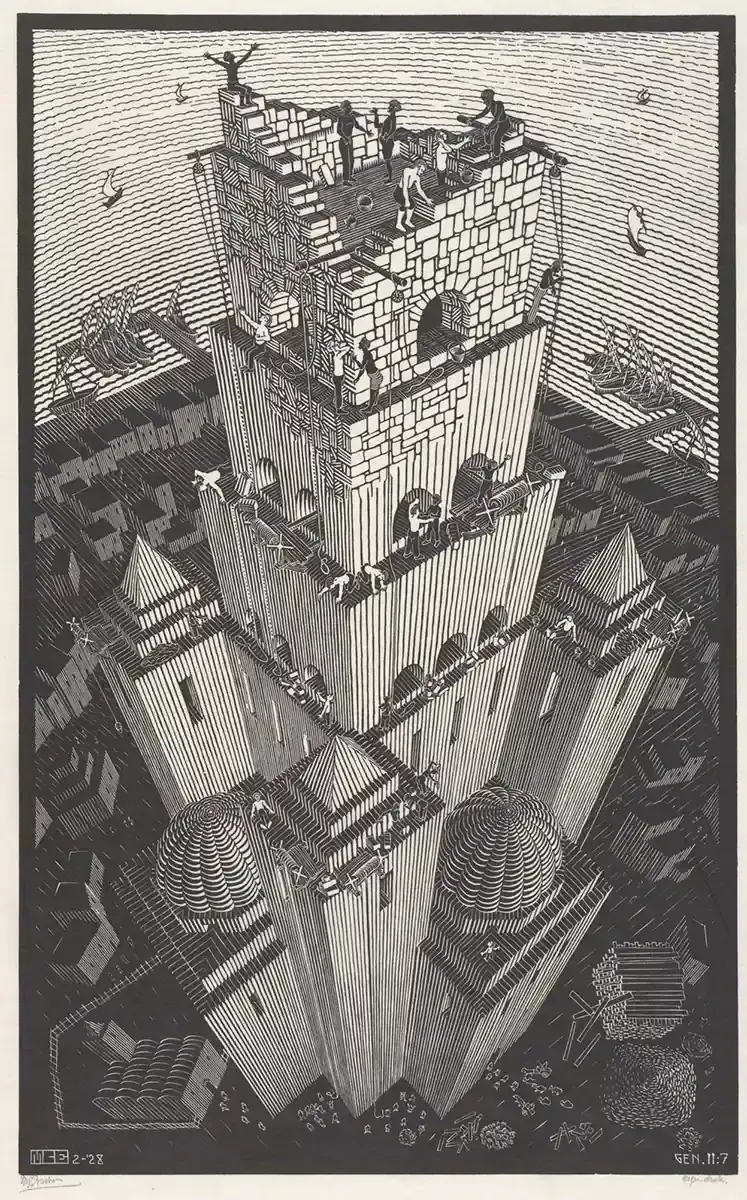
Both Christ, the Word of God, and the Bible, the Word of God, are incarnational. Just as Christ is fully God and fully man, so the Bible was fully inspired by God but fully written by men. That does not mean that all language is incarnational; in our broken world of sin and depravity, all things, including language, have been corrupted by the fall. Man, nature, and language alike are subjected to the curse (see Genesis 3:19, Romans 8:20-22, Genesis 11:7). Still, the incarnational nature of Christ and the Bible suggests that human language has the potential to be incarnational.
In a prose piece he wrote titled “Essays Upon Epitaphs,” Romantic poet William Wordsworth searches for a poetic language that will not be what clothing is to the body, but what the body is to the soul. One of the reasons that poetry has, until quite recently, been privileged over prose is because it was understood that poetry was a kind of purified language that brought us closer to the pre-fallen language of Adam, to that Edenic grammar by which Adam named the animals (Genesis 2:19-20). In the language of Adam, I imagine, there was an incarnational relationship between signifier and signified like that between body and soul.
In the United States of America, our republic rests upon a document that, though not sacred like the Bible, is yet composed of carefully chosen words and phrases that wrap a blanket of protection around our 250-year experiment in representational democracy.
God spoke the world into being (Genesis 1:3, 6, 9, etc.), and Jesus, John 1:3 suggests, is that creative Word, that Logos. According to Athanasius’s capsule summary of the Orthodox doctrine of theosis, God, in Christ, became like us so that we can become like him. That the Word became flesh offers hope that human language can point to the divine. The Orthodox defenders of icons believe that the incarnation baptized physical matter as a fit receptacle for divine meaning and presence; hence, Christ can be rendered in pictorial form without violating the second commandment against graven images (Exodus 20:4). Just so, I would argue, when the Word became flesh, it began the renewal of fallen language even as it began the renewal of fallen man.
Why does this matter to the church and to Western civilization? Because it should encourage us not to abandon language as a vehicle for prayer, for doctrine, for public discourse, for laws, and for passing down the Greco-Roman, Judeo-Christian heritage that birthed our nation. Religious and political freedom rests upon our ability to communicate with our neighbor, to make contracts and covenants that bind us to stable, meaningful words. There was a time not so long ago when the greatest compliment you could pay a young man was to tell him he was a man of his word.
Christians serve an incarnate, risen savior who was and is and will forever be the Word of God. We further ground our faith, doctrine, and practice in a sacred book that is also the Word of God. If we lose that double foundation, the church will collapse or, worse, become unrecognizable.
In the United States of America, our republic rests upon a document that, though not sacred like the Bible, is yet composed of carefully chosen words and phrases that wrap a blanket of protection around our 250-year experiment in representational democracy. I speak, of course, of our constitution, a covenant made up of words that have a fixed meaning but that can bend and flex, as our body can bend and flex, to express the health and growth of our nation’s soul.
Only because words possess the ability to convey a stable and transcendent meaning was Jesus able to promise that if we abide in his word we “will know the truth, and the truth will set [us] free” (John 8:31-32), and Patrick Henry to exclaim, “Give me liberty or give me death!”
From the Editors: Highlight the white text to see our responses to the claims.
1) Claim: People defined "family" and "woman" as one thing only to maintain power for their view. These definitions are oppressive now.
Response: While words can be used not as intended to maintain power, words are not necessarily claims of power. Contrary to Gorgias' claims, there is reality that can be known, and not only known, but communicated - through words. As Plato points out, words, like "family" and "woman", point to something real, and as the apostle John points out, we can know this reality. Words do not simply mean whatever one wants them to mean for the supposed purpose of maintaining power. Their meaning is rooted in the reality that they point to, whether one likes this reality or not.2) Claim: The fix for violent language is not better communication but censorship.
Response: Words can certainly be used for harm, but this is not the same thing as violence. Words (signifiers) point to real, transcendent, or objective things (signifieds). Equating harmful speech to physical violence collapses two distinct signifieds into one: violence is no longer just a punch or kick; it is now also hurt feelings or offense. It makes violence a flexible label that can be applied based on subjective experience rather than objective reality. Essentially, an attempt at truthful discourse for one person is violence to another, rather than the same thing for both. Harmful words do not mean the person who spoke them is an aggressor simply seeking power; they may be the truth.3) Claim: Older documents and texts, like the Constitution, should evolve or be re-interpreted over time to adapt to societal changes.
Response: Older documents maintain their original meaning because their words point to fixed, non-changing realities. If contracts and documents can change, then we have nothing stable to agree on and they lose their power. While Nietzsche and Gorgias thought that words could not adequately convey truth, this makes words mean nothing more than what one wants them to mean, and this is not the view of Plato or the Bible or the American Founders. We must interpret documents like the Constitution as they were written.This is an interview from the Orthodoxy podcast in which Andy Schmitt talks to Dr. Louis Markos about the very topics written about in this essay. Please listen to and share this interview with someone who may be interested.