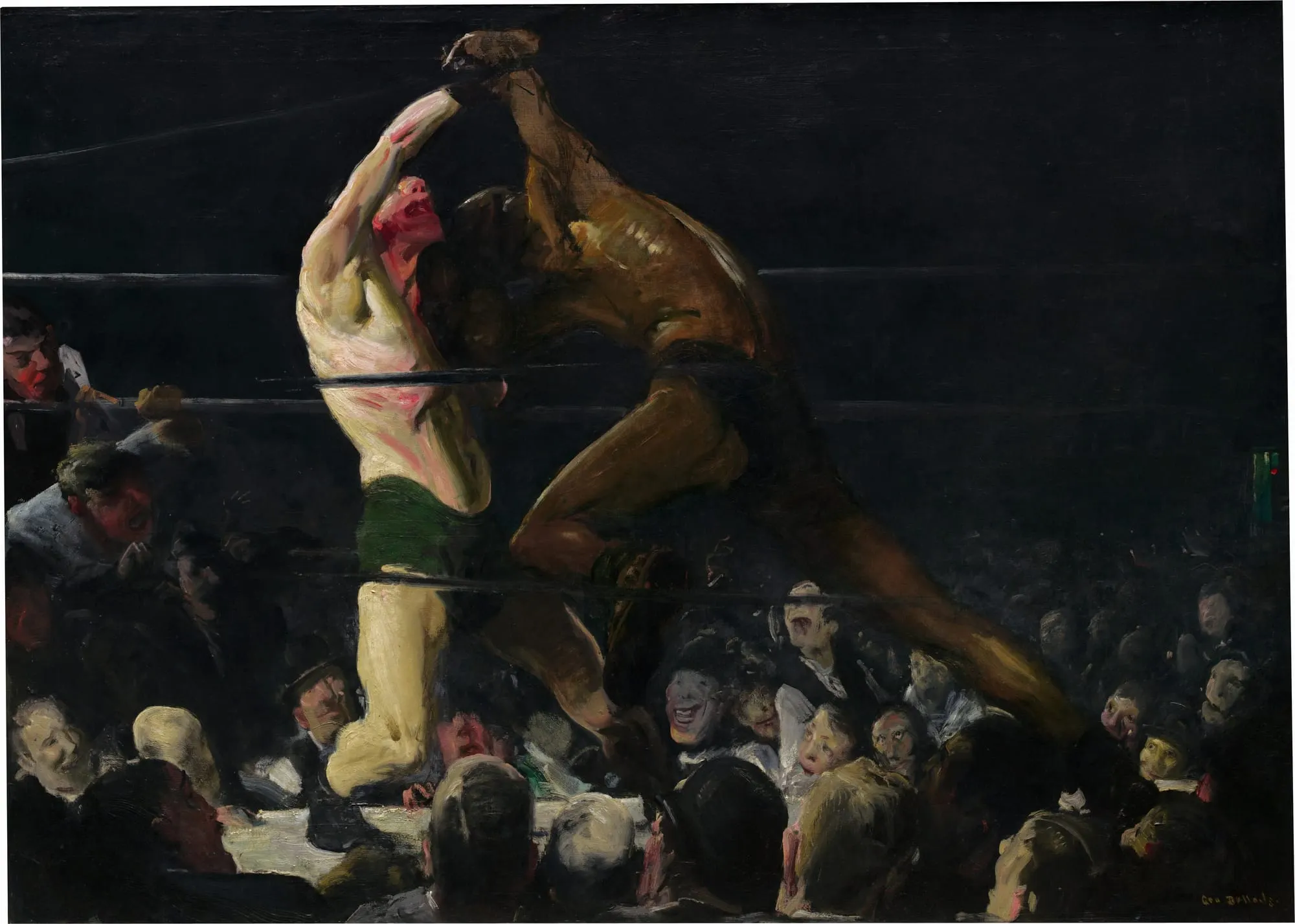
From the Editors: This article's artwork depicts a boxing match, with the boxer on the right in what seems like a dominant position, likely to win at any moment. But can we really tell who will win - the boxer on the left or the boxer on the right - from this single moment in time? What makes any competition exciting is not knowing who the winner will be and knowing that anything can change. And it's even more exciting when a competition going one way takes a turn the other way - when an underdog makes a comeback. After reading this article, a question you can ask yourself is - how can I let the prophets of the past ignite an enthusiasm and hope to win when liberalism has taken so much territory? And another question is - was the boxer on the right supposed to win from the start, or is he in the middle of a comeback, a comeback from his own near defeat?
Is Western Civilization, America, perhaps even modern Christianity, on a one-way ticket to hell in the proverbial handbasket? Or are things really getting better all the time? The End is Near or Morning in America? Black pill or white pill?
The answer I wish to propose is “neither.” If we are to take our pill, the best one to take is the one proffered by all the prophets. The prophet pill is the one inscribed with “IF” in bold letters. It has always announced both doom and glory because both are possible outcomes.
In contrast to Isaiah, who is the prophet of God doing new and glorious things, the Prophet Jeremiah is famed for his black pills. Merriam-Webster defines “jeremiad” as a “prolonged lamentation or complaint” or “a cautionary or angry harangue.” The eponymous practitioner of this form was, however, a specialist in the “cautionary” version.
The prophet’s words in Jeremiah 22, verses 4 and 5, stand in for a host of other difficult pills handed out by those who speak for the Lord. “For if you will indeed obey this word,” Jeremiah announces to Jehoiakim, King of Judah, who has been oppressing his people, “then there shall enter the gates of this house kings who sit on the throne of David, riding in chariots and on horses, they, and their servants, and their people.” “But,” he continues, if you will not heed these words, I swear by myself, says the Lord, that this house shall become a desolation.”
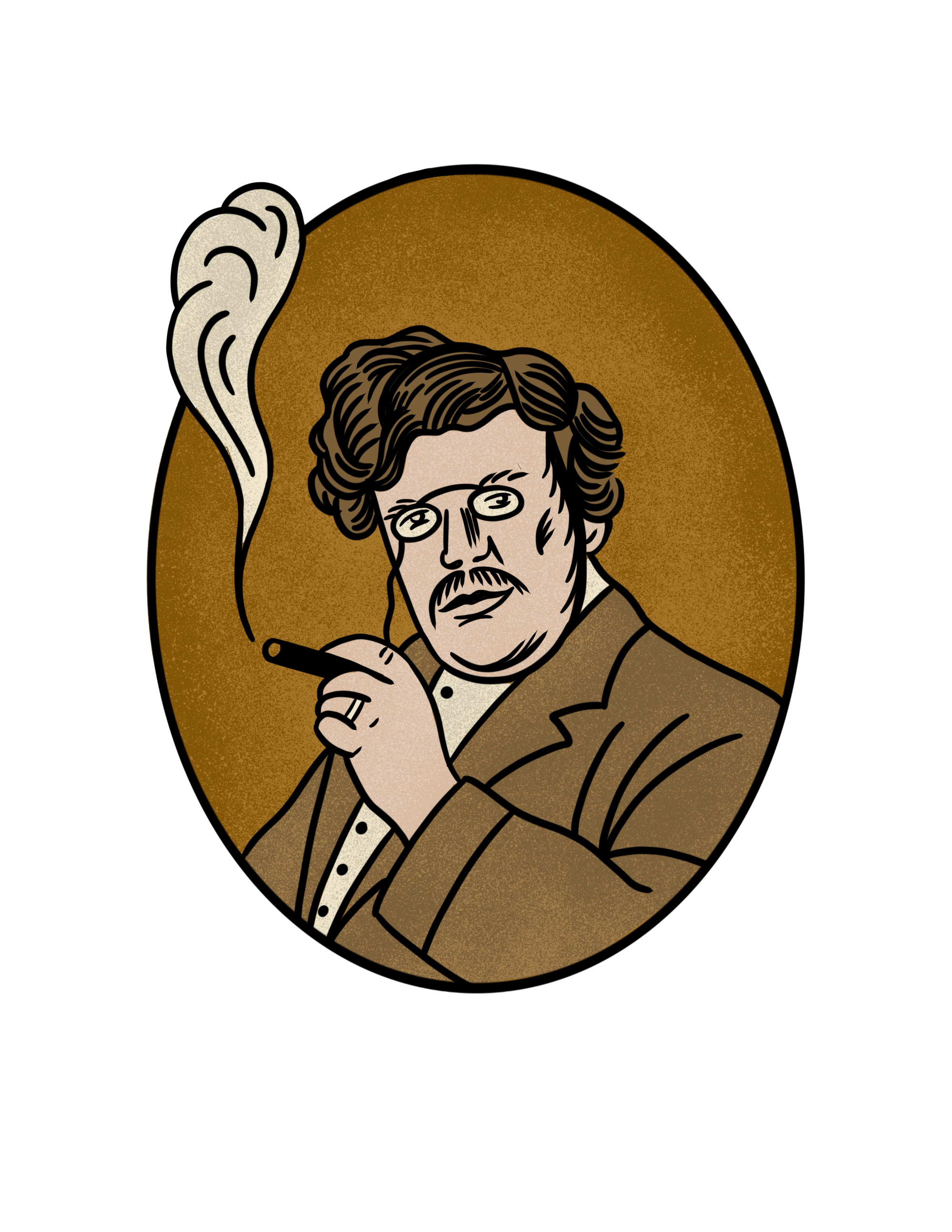
This way of speech has never gone out of style, for it is the essence of human life seen in both Hebrew and Christian lenses. While the true division among human beings might well not be between liberals and conservatives, as Gilbert and Sullivan had it, but between those who are fatalists and those who believe that our lives are stories with characters who can make choices. This was G. K. Chesterton’s contention in his classic Orthodoxy, where he argued that the Christian account of life was superior to that of the fatalists.
To the Buddhist or the eastern fatalist existence is a science or a plan, which must end up in a certain way. But to a Christian existence is a STORY, which may end up in any way. In a thrilling novel (that purely Christian product) the hero is not eaten by cannibals; but it is essential to the existence of the thrill that he MIGHT be eaten by cannibals. The hero must (so to speak) be an eatable hero. So Christian morals have always said to the man, not that he would lose his soul, but that he must take care that he didn't. In Christian morals, in short, it is wicked to call a man “damned”: but it is strictly religious and philosophic to call him damnable.
Nor did he think that this was only true of persons. It was also true of nations and even civilizations. Indeed, one reason what we call Western Civilization—that amazing dynamic reality that came from biblical religion, Greek philosophy, and Roman organization—has been so vibrant for two thousand years is that those who love it have constantly been aware of its fragility. Those who love what has been passed down and what has been built upon these bases have regularly warned that it is damnable but not damned.
Civilization, coming from the Latin civitas, city, is a reality that is large and complex. Just as a city has many neighborhoods, buildings, institutions, and discrete communities, so too does a civilization. People are born and die. Some born into the civilization are not formed to understand how it was built, what makes it operate, or what causes it to grow. Groups move in and groups move out. Some of those who are in the civilization are not of it. Some who move in are not inclined to be of it. Others selfishly act to make people forget its history and what makes it work. Still others work to renew the attachments to it. They turn the attention of others to the history of the civilization and why it ought to be renewed.
These last are the prophets. Regarding the future, these civilizational prophets suffer, if you will, a double vision with an “if…if” structure. They know that doom is possible but not certain, that their youth and the youth of their civilization can be renewed like the eagle’s if only they will return to the Lord and to their own senses.
To return to the Lord means to turn again to the past and the present, to see again God’s faithfulness and the way to respond to that faithfulness. The prophets are thankful to God for his marvelous Providence in giving to them a heritage that is material and economic, perhaps, but, more importantly, intellectual and spiritual. They have in mind the glory of those saints and heroes, both the extraordinary ones and those we might call ordinary, who have taken their talents, no matter how small, and improved them.
To return to the Lord means to turn again to the past and the present, to see again God’s faithfulness and the way to respond to that faithfulness.
We who wish to see the renewal of that Western Civilization have had plenty of those prophets over the last century. To name just a few, there are: G. K. Chesterton, C. S. Lewis, T. S. Eliot, Josef Pieper, Francis Schaeffer, Mother Teresa, Malcolm Muggeridge, and Aleksandr Solzhenitsyn. We will concentrate on the first and the last.
As Duncan Reyburn details in his recent book, The Roots of the World: The Remarkable Prescience of G. K. Chesterton, Chesterton’s record of accurate predictions includes: the “stifling and often insane bureaucracy” of western countries, the fall of communism in Russia, the revival of small nations and empires at the same time as an impersonal globalism, a Second World War to follow the one his friend H. G. Wells had called “The War to End War,” the sexual revolution, and even the shackles of a regime based upon “healthcare.”
Yet, as I have been arguing, it is not simply predictions of doom—even accurate predictions—that makes a prophet. It is the ability to speak on behalf of the Lord the words that lead to life. Prophets, it is said, do not merely foretell events. They tell forth what God wants us to do. They tell us what we have avoided and forgotten amid plenty and luxury.
Chesterton’s moral edge is found in his observations about the problems in our civilization. “Civilization has run on ahead of the soul of man,” he wrote in 1902, “and is producing faster than he can think and give thanks.”
In other words, the problems of our civilization are not caused by an excess in technical or productive power. They are caused by a defect in our thought and thanksgiving.
This theme is everywhere in these prophets. Aleksandr Solzhenitsyn, the literary documentarian and artist of the horrors of Soviet Communism, diagnosed the heart of the problems of the modern world—both in his own sad homeland and the supposedly free West—as those of the inner man. As he wrote in his essay “We Have Ceased to See the Purpose,” “Progress was understood to be a shining and unswerving vector, but it turned out to be a complex, twisted curve, which has once more brought us back to the very same eternal questions that loomed in earlier times and before—except that facing these questions then was easier for a less distracted and disconnected mankind.”
It is only through facing eternal questions that we can find a way out of our own self-induced civilizational doom. Indeed, only by facing the source of and the answer to all the questions can we avoid that destruction. As Solzhenitsyn said in his 1983 Templeton Address, the problems of the twentieth century can be summed up in the answer he got from an old Russian about what was wrong: “‘Men have forgotten God.’ The failings of human consciousness, deprived of its divine dimension, have been a determining factor in all the major crimes of this century.” Our only hope, he affirmed, was to “reach with determination for the warm hand of God, which we have so rashly and self-confidently pushed away.”
Chesterton’s record of accurate predictions includes: the “stifling and often insane bureaucracy” of western countries, the fall of communism in Russia, the revival of small nations and empires at the same time as an impersonal globalism, a Second World War to follow the one his friend H. G. Wells had called “The War to End War,” the sexual revolution, and even the shackles of a regime based upon “healthcare.”
It is God, our help in ages past, to whom we must turn. If we are to experience Him as our hope for years to come, we must study thoughtfully and thankfully those great prophets and saints of old. Furthermore, we must imitate them. They knew that whether we arrive at doom or glory is not due to a cold fate but of a decision to grasp the warm divine hand where we are, here and now. “The world,” Chesterton wrote in his essay, “It Wobbles”:
is what the saints and the prophets saw it was; it is not merely getting better or merely getting worse; there is one thing that the world does; it wobbles. Left to itself, it does not get anywhere; though if helped by real reformers of the right religion and philosophy, it may get better in many respects, and sometimes for considerable periods. But in itself it is not a progress; it is not even a process; it is the fashion of this world that passeth away. Life in itself is not a ladder; it is a see-saw.
Neither presumption nor despair is any way to live. While we do not know what tomorrow may bring, we do know that there will be two ways open. If we heed the God men have forgotten, if we are brought to thought and thanksgiving, the future will be bright no matter the circumstances.
This is an interview from the Orthodoxy podcast in which Andy Schmitt talks to Dr. David Deavel about the very topics written about in this essay. Please listen to and share this interview with someone who may be interested.