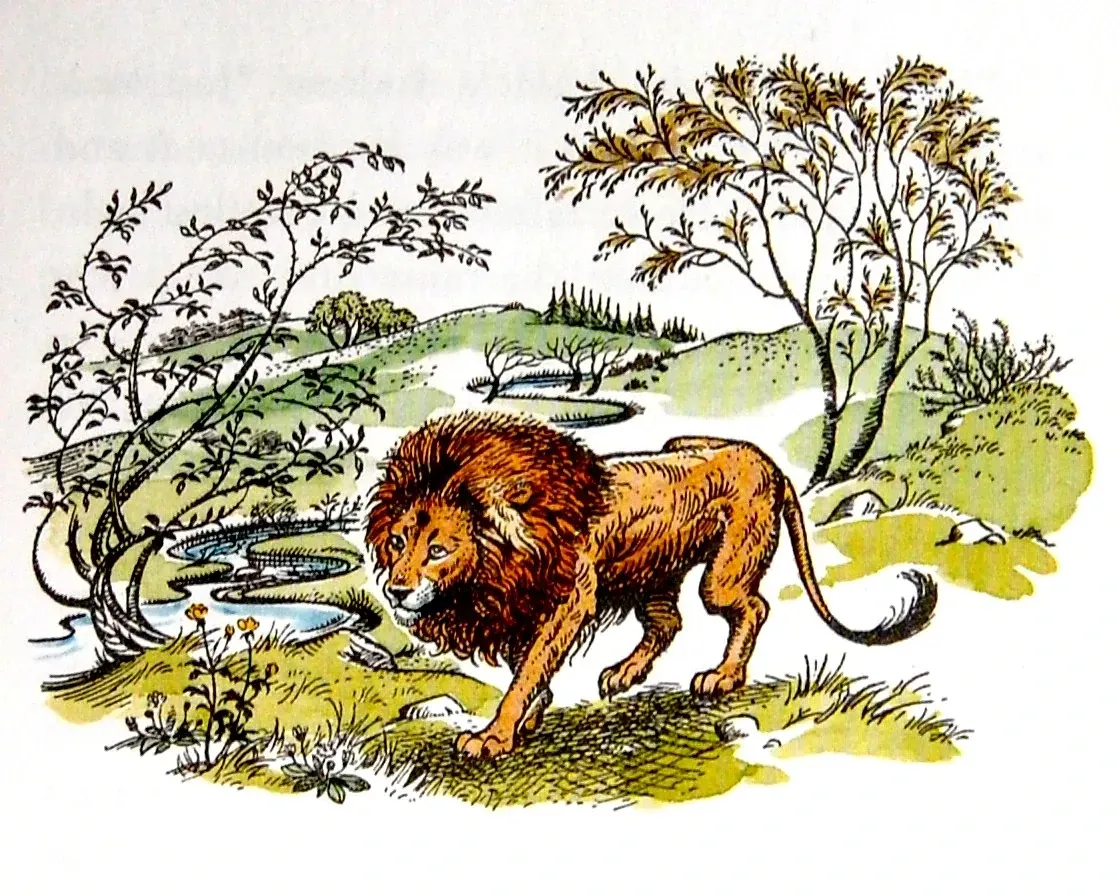
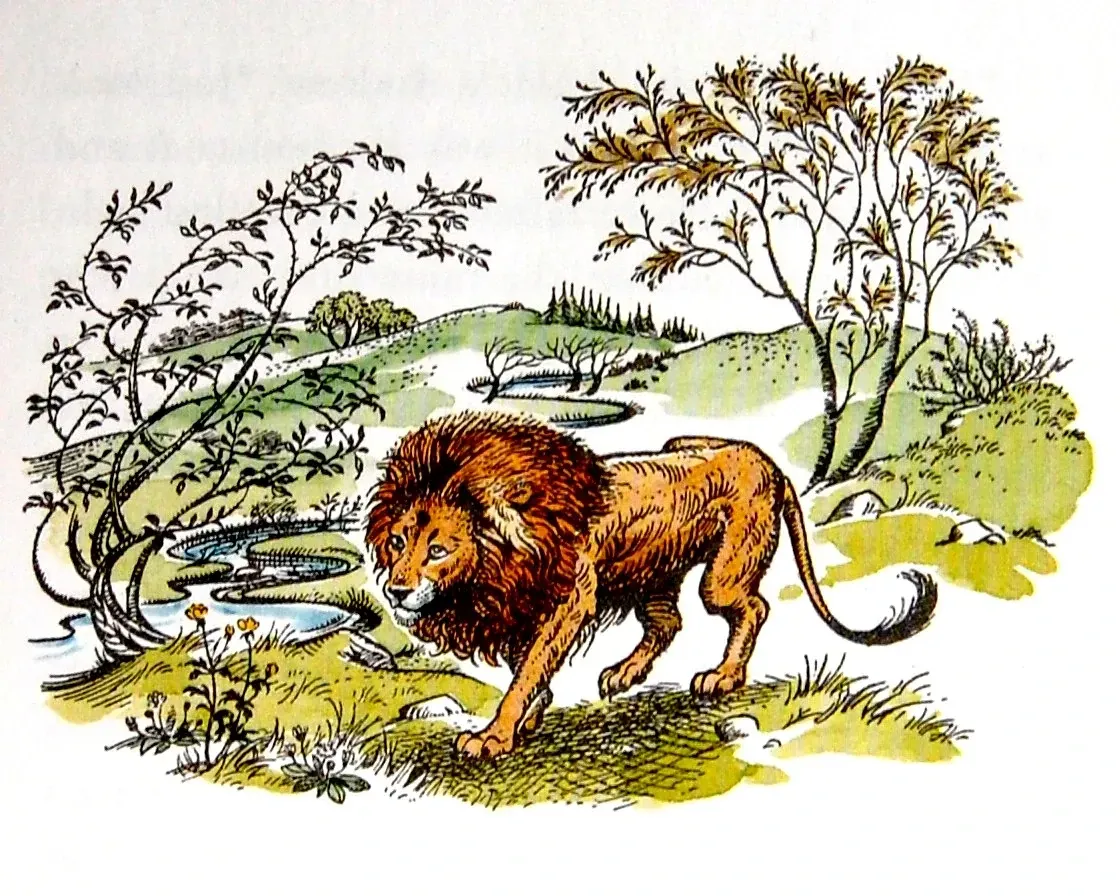
It is now official. Meryl Streep will be voicing Aslan for the spring 2027 release of Greta Gerwig’s film version of The Magician’s Nephew. At this point, Aslan is being referred to as a lion, not a lioness, and as a “he,” but the implications are troubling. Although I am willing to hold off my critique of the film until it is ready for viewing, I feel compelled to explain why any attempt to shift the sex/gender of Aslan from male to female is both unacceptable and heretical.
Aslan, C. S. Lewis made clear, is not an allegory for Christ. But that does not mean that there is no connection between the Lion of Narnia and the Lion of Judah. The Chronicles of Narnia, Lewis explained, are not allegories but supposals. The purpose of The Lion, the Witch and the Wardrobe is not to convert the gospel story into a one-to-one allegory, as Bunyan’s Pilgrim’s Progress converts the struggles and triumphs of the Christian life into an allegory, with the temptations of despondency, vanity, and despair represented as a slough, a fair, and a giant.
Jesus is more than the Son of God; he is God the Son. He is a member of the Triune Godhead who exists eternally in a filial relationship with God the Father.
Rather, it supposes a hypothetical scenario: what if the Second Person of the Trinity (God the Son) were to be incarnated, not only on the earth, but on a magic world of talking animals and living trees? What might he be like? Lewis’s answer was that he would be a Lion, the King of the Woods and the Son of the Emperor over the Sea. Lewis says so most directly in a letter he wrote to a fifth-grade class in Maryland on May 24, 1954.
“You are mistaken when you think that everything in the book ‘represents’ something in the world. Things do that in The Pilgrim’s Progress but I’m not writing in that way. I did not say to myself ‘Let us represent Jesus as He really is in our world by a Lion in Narnia’: I said ‘Let us suppose that there were a land like Narnia and that the Son of God, as He became a Man in our world, became a Lion there, and then imagine what would happen.’ If you think about it, you will see that it is quite a different thing” (anthologized on pp. 479-480 of Volume 3 of The Collected Letters of C. S. Lewis; it can also be found on pp. 44-45 of Letters to Children).
Jesus is more than the Son of God; he is God the Son. He is a member of the Triune Godhead who exists eternally in a filial relationship with God the Father. In Book IV, chapter 4 of Mere Christianity, Lewis offers a number of metaphors to describe the relationship between the First and Second Persons of the Trinity, but then returns to that of Father/Son, for “God knows how to describe Himself much better than we know how to describe Him. He knows that Father and Son is more like the relationship between the First and Second Persons than anything else we can think of. Much the most important thing to know is that it is a relation of love. The Father delights in His Son; the Son looks up to His Father.” Lewis then concludes by arguing, after Augustine, that the “union between the Father and Son is such a live concrete thing that this union itself is also a Person,” the Holy Spirit.
Notice that Father/Son is more than a metaphor. Jesus compares himself to a hen (Luke 13:34), as he does to a door (John 10:7), a light (John 8;12), and bread (John 6:35), but he is merely like those things. He is not simply like a son. He is God the Son. The Father-ness and Son-ness of the First and Second Persons of the Trinity are metaphysical realities, not cultural accommodations. When Jesus compares himself to the Good Shepherd (John 10:11), he transcends slightly the figurative language of the other “I am” claims in John’s Gospel, but even here, though he shepherds his people, he is not a shepherd in the eternal, ontological way that he is God the Son.
As the Christ of Narnia, Aslan must be male, for he is the Son of the Emperor over the Sea. The relationship is that of Father/Son, not Father/Daughter or Mother/Daughter. To suggest that Aslan could be female—that, in the case of Narnia, lion and lioness are interchangeable—is tantamount to making the heretical claim that Jesus could just as well have been the Daughter of God as the Son of God. Many fans of Lewis know he opposed female priests. What most do not realize is that Lewis’s opposition was not exegetical, based on a close reading of the epistles of Paul, but sacramental, based on the role that the priest plays vis-à-vis Jesus and the language through which God chose to express the relationship within the Godhead and between God and Man.
In “Priestesses in the Church?” (anthologized in God in the Dock), Lewis plays a little game of supposals with an unnamed reformer who thinks that the Fatherhood of God and the Son-hood of Jesus are interchangeable. “Suppose he says that we might just as well pray to ‘Our Mother which art in heaven’ as to ‘Our Father’. Suppose he suggests that the Incarnation might just as well have taken a female as a male form, and the Second Person of the Trinity be as well called the Daughter as the Son [we might add “lioness as lion”]. Suppose, finally, that the mystical marriage were reversed, that the Church were the Bridegroom and Christ the Bride. All this, as it seems to me, is involved in the claim that a woman can represent God as a priest does.”Lewis’s answer to these supposals is emphatic and unwavering. “Now it is surely the case that if all these supposals were ever carried into effect we should be embarked on a different religion. Goddesses have, of course, been worshipped: many religions have had priestesses. But they are religions quite different in character from Christianity.” But, Lewis continues, speaking as fairly as he can for the opposing view, since “God is in fact not a biological being and has no sex, what can it matter whether we say He or She, Father or Mother, Son or Daughter?”
As the Christ of Narnia, Aslan must be male, for he is the Son of the Emperor over the Sea.
Again, Lewis is emphatic in his reply: “But Christians think that God Himself has taught us how to speak of Him. To say that it does not matter is to say either that all the masculine imagery is not inspired, is merely human in origin, or else that, though inspired, it is quite arbitrary and unessential.” Those who would innovate the gendered language of the Scriptures and the Church “are really implying that sex is something superficial, irrelevant to the spiritual life. To say that men and women are equally eligible for a certain profession is to say that for the purposes of that profession their sex is irrelevant. We are, within that context, treating both as neuters.”
In a democratic society, Lewis concedes, “the kind of equality which implies that the equals are interchangeable (like counters or identical machines) is, among humans, a legal fiction. It may be a useful legal fiction. But in church we turn our back on fictions. One of the ends for which sex was created was to symbolize to us the hidden things of God. One of the functions of human marriage is to express the nature of the union between Christ and the Church. We have no authority to take the living and semitive figures which God has painted on the canvas of our nature and shift them about as if they were mere geometrical figures.”
Lewis ends “Priestesses in the Church?” with a warning that needs to be heard with equal force by those who would tinker with the church, the sexes, and fictional incarnations of God the Son in magical worlds.
Lewis refers here to Ephesians 5:31-32 (ESV). After quoting Genesis 2:24 on the biblical nature of marriage and intercourse between the sexes (“Therefore a man shall leave his father and mother and hold fast to his wife, and the two shall become one flesh.”), Paul connects it to the coming union between Christ (the Bridegroom) and the Church (his Bride): “This mystery is profound, and I am saying that it refers to Christ and the church.” To turn Christ into Bride and the Church into Bridegroom is to abandon Christianity for another (pagan, heretical) religion.
God did not make men and women to be interchangeable: “So God created man in his own image, / in the image of God he created him; / male and female he created them” (Genesis 1:27). It is not only our bodies but our souls that are masculine and feminine. Hinduism, with its belief in reincarnation, can imagine the soul of a man being reborn in the body of a woman, or vice versa, but not Christianity. Aslan is no more a reincarnation of Jesus than he is an allegory. He is, again, what God the Son might have been had he been incarnated in Narnia. His maleness (or, to be more accurate, his Son-ness) is not an arbitrary counter. It is part of God’s eternal relationship within the Trinity and his self-revelation in the Bible.


Lewis ends “Priestesses in the Church?” with a warning that needs to be heard with equal force by those who would tinker with the church, the sexes, and fictional incarnations of God the Son in magical worlds. The relationship between masculine and feminine, Lewis suggest, is like a formal, choreographed Ball. It exists, he argues, “to stylize something which is natural and which concerns human beings in their entirety—namely, courtship. We cannot shuffle or tamper so much [with the rules and etiquette of courtship]. With the Church, we are farther in: for there we are dealing with male and female not merely as facts of nature but as the live and awful shadows of realities utterly beyond our control and largely beyond our direct knowledge. Or rather, we are not dealing with them but (as we shall soon learn if we meddle) they are dealing with us.”
In Chapter 3 of The Magician’s Nephew, Lewis says of the forbidden, esoteric investigations of Uncle Andrew that he “was working with things he did not really understand; most magicians are.” To alter or switch or transition the maleness of Aslan is to tamper with metaphysical realities we barely understand. Masculinity and femininity are creations of God, essences that he wrote into the fabric of his cosmos. They are not to be handled lightly.
Individuals, congregations, and denominations that meddle with such things, particularly those who claim to do so in the name of Jesus and the New Testament, will find themselves met by the same terrifying response the provoked demon made to the seven sons of Sceva who thought to exorcise it: “‘Jesus I know, and Paul I recognize, but who are you?’ And the man in whom was the evil spirit leaped on them, mastered all of them and overpowered them, so that they fled out of that house naked and wounded” (Acts 19:15-16).